Income tax filing for Year of Assessment (YA) 2027 generally covers income earned in 2026. For employees, this is usually straightforward. Self-employed individuals must account for business income and expenses. Company directors have another detail to consider: when their fees become taxable. The rules aren’t the same for everyone.
Understanding Income Tax Filing for YA 2027
The first thing to check is the income period. YA 2027 does not mean income earned during 2027. It generally refers to the previous year’s earnings, although some businesses follow a different accounting period.
What Does YA 2027 Cover?
YA 2027 generally covers income earned between 1 January and 31 December 2026. Singapore uses a preceding-year basis when assessing individual income tax.
For someone earning a monthly salary, this is fairly easy to follow. Business owners may need to look a little closer. A sole proprietor with a financial year ending on 31 March, for example, may have a different basis period.
This is worth checking before preparing your income tax return. Reporting income under the wrong period can lead to incorrect figures.
Who Needs to File?
You generally need to file a return when your income meets any of these conditions:
- Your total income was more than S$22,000.
- Your net profit from self-employment was more than S$6,000.
- You received Singapore-sourced income as a non-resident that is not subject to withholding tax.
- IRAS sent you a notice asking you to file.
These are general filing criteria. An IRAS notice still needs attention, even when your income is below the stated amounts.
There is also the No-Filing Service (NFS). Some taxpayers are included in this arrangement and do not need to submit a return. However, they should still check the information pre-filled by IRAS through the myTax Portal. Missing income or incorrect details should be corrected.
Business income needs a little more work. You cannot simply take the amount received from customers and enter it as your taxable income. Allowable expenses must be considered too.
How Business Profits Are Calculated
Self-employed income tax is generally calculated using adjusted business profit. Start with your business revenue. Then deduct expenses incurred wholly and exclusively to earn that income.
Office rent and business supplies may qualify. Personal shopping does not, even when you use the same bank account for business and personal spending. Keep the two separate.
Receipts matter here. So do invoices, bank statements and payment records. IRAS requires self-employed individuals to retain proper business records for at least five years. Do not wait until filing season to look for them.
| Annual business revenue | Reporting requirement |
|---|---|
| S$200,000 or less | 2-line statement showing revenue and adjusted profit or loss |
| More than S$200,000 | 4-line statement showing revenue, gross profit or loss, allowable deductions and adjusted profit or loss |
| S$500,000 or more | Certified profit and loss account and balance sheet, as required by IRAS |
The reporting format depends on annual revenue. Check the figures before choosing which statement applies to your business.
How to File Income Tax in Singapore
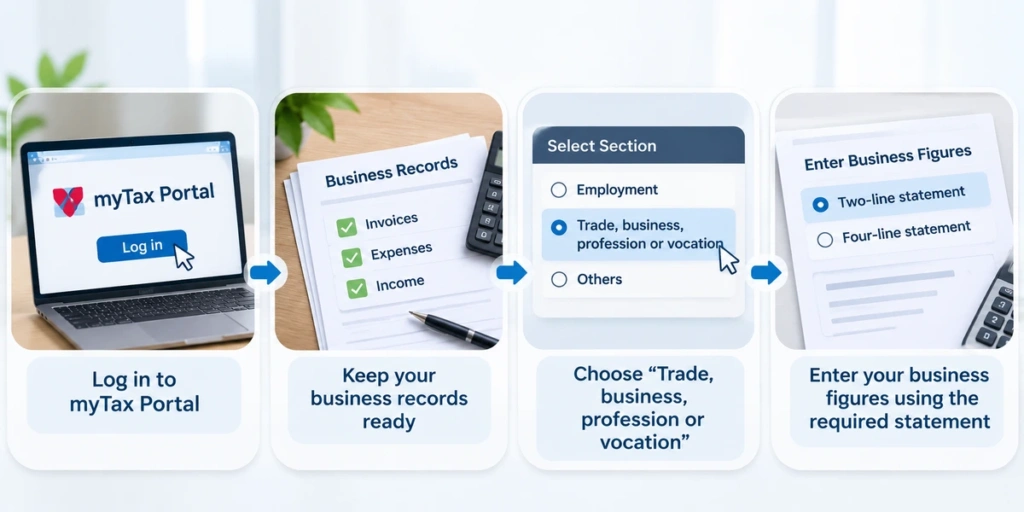
You submit your return through myTax Portal. Have your business records nearby before you begin. Searching for old invoices while filling in the form can make the process unnecessarily difficult.
When working out how to file income tax in Singapore, go to the section for trade, business, profession or vocation. Enter your business figures using the required two-line or four-line statement.
You may also need details of other income. Keep these records ready:
- Revenue for the relevant accounting period.
- Receipts for allowable business expenses.
- Rental or other taxable income, where applicable.
- Financial statements, if required.
- Details of eligible tax relief claims.
Read through the figures once more before submitting. An income tax return should include all taxable income, not just the money earned from your main business.
Tax Responsibilities of Company Directors
A director’s income is not always limited to a monthly salary. There may be fees, bonuses or other payments from the company. The way these amounts are taxed depends on what they are and when the director becomes entitled to receive them.
How Director Fees Are Taxed
The approval date matters when reporting director fees. Fees approved in arrears are generally taxable when the company’s members approve the payment at the Annual General Meeting.
Fees approved in advance follow a different timing rule. They are generally taxable as the director performs the services and becomes entitled to payment.
This is an important part of director fee tax in Singapore. A fee for work carried out in one financial year may fall into a later Year of Assessment if approval happens afterwards.
Check the meeting minutes and payment records. The amount alone does not tell you which year it belongs to. Salaries, bonuses and other taxable employment benefits must also be considered.
Personal Tax Is Separate From Company Tax
The company files its corporate tax return. The director files a personal return. These are two separate responsibilities, even when the director owns the business.
There is another distinction worth remembering. Dividends from Singapore-resident companies operating under the one-tier corporate tax system are generally not taxable in the shareholder’s hands. Salary and director fees are different.
During personal tax filing, check whether you qualify for reliefs. The conditions vary depending on the claim, and the total personal income tax relief is subject to an S$80,000 cap for each Year of Assessment.
Filing Dates and Final Checks
The due date is easy to overlook when you are busy sorting out income and expenses. Put it on your calendar early. That leaves time to check your records rather than rushing through the return.
What Is the Income Tax Filing Deadline 2027?
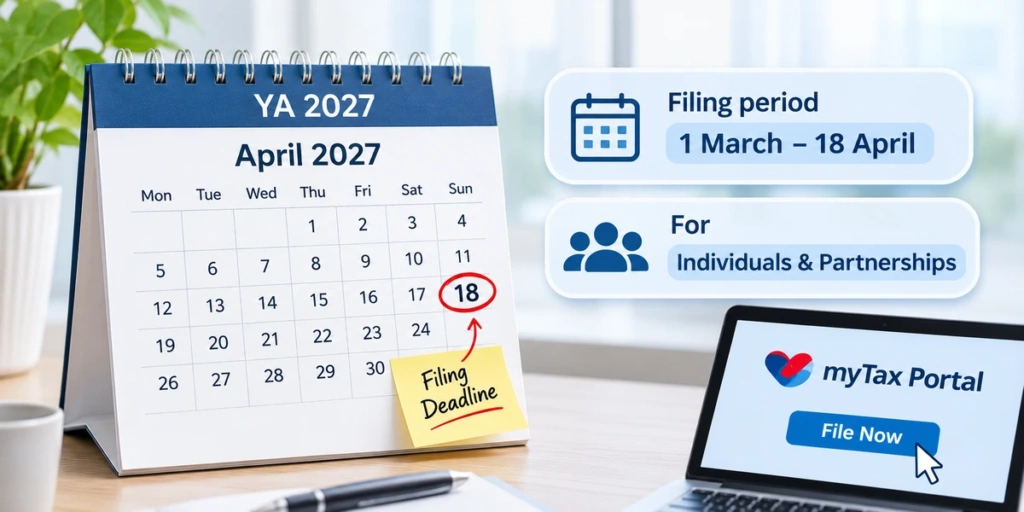
The income tax filing deadline 2027 for individual and partnership returns is 18 April 2027, according to the published IRAS calendar. The filing period generally runs from 1 March to 18 April.
Check myTax Portal when the filing season opens. Do not assume that your employer’s submission of salary details means you are exempt. Your filing status depends on the instructions from IRAS.
Check Your Return Before Submission
Before completing personal tax filing, go back through the figures. Check your business revenue, expense claims and director fees. Make sure each amount is reported in the correct assessment year.
The requirements for income tax filing in Singapore 2027 depend on the income you receive. A freelancer may have business profits to declare, while a director may need to account for fees and salary. If you are unsure how to file income tax in Singapore, refer to the relevant IRAS guidance before submitting.
For help organising records and preparing for personal tax filing, Entrust can assist with the information needed before submission. Check your figures against your accounts and the latest IRAS instructions.